


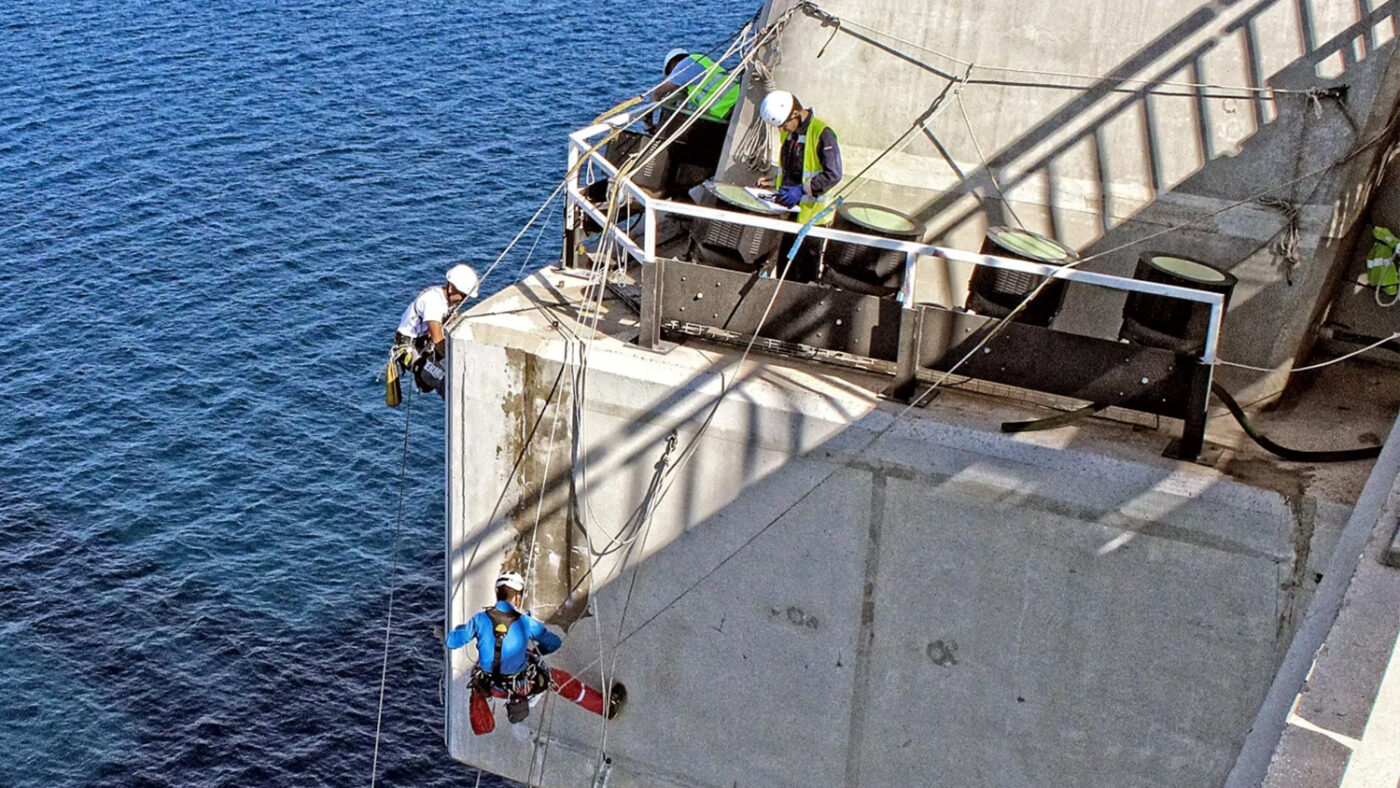

Rehabilitation and concrete repair are essential processes in extending the service life of structures, restoring their functionality, and ensuring safety. Over time, concrete structures can deteriorate due to environmental exposure, overloading, design flaws, or lack of maintenance. Timely repair and rehabilitation help avoid costly replacements and structural failures.
Common Causes of Concrete Deterioration
- Corrosion of Reinforcement: Caused by water ingress, chloride attack, or carbonation.
- Cracking: Due to shrinkage, thermal movement, or structural overloading.
- Chemical Attack: Sulfates, acids, or alkali-aggregate reactions damaging the concrete matrix.
- Freeze-Thaw Damage: Expansion and contraction cycles leading to scaling or spalling.
- Poor Construction Practices: Inadequate curing, improper mix design, or low-quality materials.
Steps in Rehabilitation and Concrete Repair
- Condition Assessment
- Visual inspection and crack mapping
- Non-destructive testing (NDT) such as rebound hammer, ultrasonic pulse velocity
- Core sampling and laboratory analysis
- Root Cause Analysis
- Identifying the reason for distress (corrosion, settlement, overload, etc.)
- Structural evaluation and load capacity check
- Repair Planning
- Selecting appropriate repair materials (epoxy, polymer-modified mortar, micro-concrete)
- Determining the repair method (patching, jacketing, grouting, shotcreting)
- Preparing detailed specifications and cost estimates
- Execution of Repairs
- Surface preparation (removal of loose concrete, cleaning reinforcement)
- Application of bonding agents and repair mortar
- Recasting or jacketing for major structural repairs
- Proper curing and quality control
- Preventive Measures
- Applying protective coatings or sealants
- Improving drainage to prevent water ingress
- Regular inspection and maintenance schedule
Techniques for Concrete Repair
- Crack Injection: Epoxy or polyurethane injection for structural cracks
- Patching & Resurfacing: Using polymer-modified mortars
- Cathodic Protection: To stop reinforcement corrosion
- Fiber-Reinforced Polymer (FRP) Wrapping: Strengthening beams, columns, and slabs
- Shotcreting or Guniting: Sprayed concrete for large-area repairs
Benefits of Rehabilitation
- Restores structural strength and stability
- Extends the service life of the structure
- Improves aesthetics and functionality
- Minimizes downtime and cost compared to reconstruction
- Enhances safety and compliance with codes
Applications
- Bridges and flyovers
- Industrial floors and silos
- Water retaining structures (tanks, dams, canals)
- Residential and commercial buildings
- Heritage structures and monuments